Stinging insect infestations in central Alabama peak from late spring through early autumn, driven by the humid subtropical climate of Jefferson County. In established historic districts such as Highland Park, Forest…
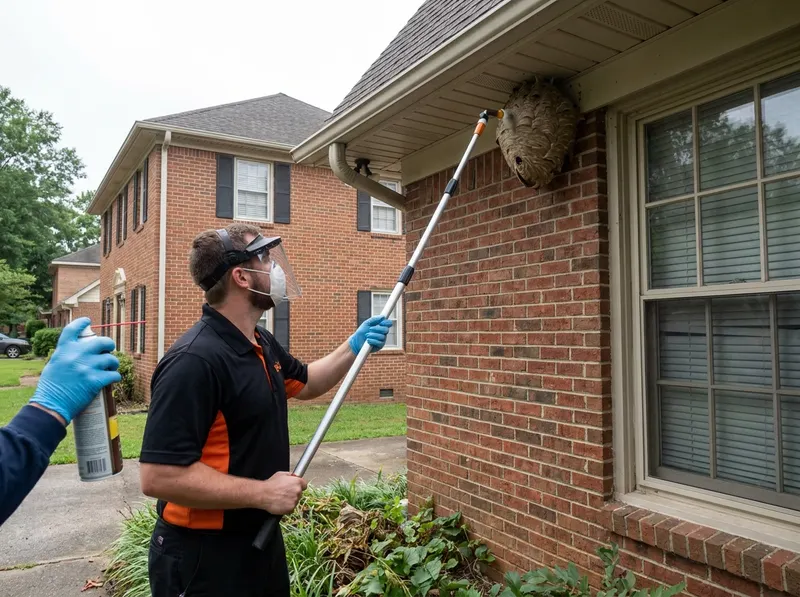
Stinging insect infestations in central Alabama peak from late spring through early autumn, driven by the humid subtropical climate of Jefferson County. In established historic districts such as Highland Park, Forest Park, and Redmont Park, European hornets and paper wasps routinely exploit architectural vulnerabilities, anchoring carton nests beneath deep heart-pine soffits, wraparound porch eaves, and attic gable louvers. Further north in Roebuck Springs and Bush Hills, unsealed fascia boards and brick-veneer weep holes provide direct ingress points into wall voids. Treating these colonies requires systematic identification of the insect species; paper wasps build open-comb umbrella nests that respond rapidly to targeted pyrethroid contact aerosols, whereas bald-faced hornets construct enclosed, football-shaped paper envelopes housing up to 400 aggressive defenders that mandate full-body protective gear and pressurized micro-injector treatments.
Subterranean yellowjacket colonies present distinct hazards near sloped landscapes and exposed root zones, common in Glen Iris, Avondale, and the terrain surrounding Red Mountain Park and Vulcan Park and Museum. Unlike aerial species, subterranean vespids repurpose abandoned rodent burrows or compost voids, expanding their colonies to thousands of workers by August. Retail propellant sprays bought at hardware stores fail against these subterranean complexes because the spray contracts the outer gallery entrance, driving agitated workers deeper into interior plumbing penetrations or crawlspaces rather than reaching the central egg-laying queen. Professional intervention utilizes non-repellent dust formulations injected through the primary entry funnel at 30 to 40 pounds per square inch of pressure, ensuring cross-contamination throughout the underground comb chambers.
Selecting professional eradication over delayed self-treatment prevents recurring structural damage and sting incidents. A standard exterior soffit application takes approximately 45 to 60 minutes per site, leaving zero volatile residues in living spaces when properly isolated from central air intakes near UAB Campus residences or Five Points South bungalows. Technicians verify colony neutralization, physically detach the carton structure to eliminate pheromone attractants that draw secondary scavengers like carpet beetles, and establish a localized residual perimeter across the void framework to prevent mid-season re-nesting.
Every job gets a firm, written price after a free on-site visit.
Tell us about your wasp and hornet nest removal job in Birmingham and we'll send a clear, written quote, usually the same day.
 Torvexa Pest Defense