Subfloor relative humidity across Jefferson County regularly exceeds 70% from May through October due to heavy Appalachian foothill precipitation and humid subtropical air masses. When crawl space air saturates,…
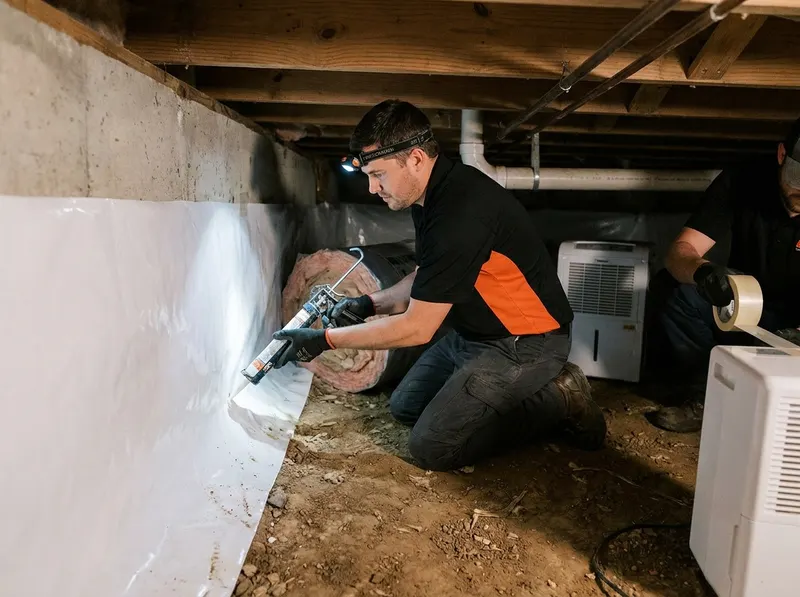
Subfloor relative humidity across Jefferson County regularly exceeds 70% from May through October due to heavy Appalachian foothill precipitation and humid subtropical air masses. When crawl space air saturates, structural framing timbers absorb ambient water, elevating subfloor wood moisture content above 19%. This specific threshold enables wood-decay fungi propagation and creates primary harborage zones for subterranean termites, camel crickets, and German or smokybrown cockroaches that require moist environments to reproduce. Properties situated in valley pockets such as Avondale, Glen Iris, and Bush Hills face amplified soil saturation compared to higher-elevation sandstone ridges in Redmont Park and Forest Park. Encapsulation resolves this biological vulnerability by establishing a sealed, mechanical thermal envelope isolated from damp foundation soil.
Material thickness directly dictates defense longevity. Standard nominal 6-mil poly ground sheets deteriorate or tear during routine utility servicing, allowing capillary water vapor to bypass the soil barrier. Precision installation requires continuous 12-mil, 16-mil, or reinforced 20-mil virgin polyethylene membranes fastened directly to concrete block or fieldstone foundation walls using masonry fasteners, with seams overlapping a minimum of 12 inches and bound with polyurethane seam tape. Foundation vents along the masonry perimeter are permanently sealed against exterior moisture ingress, satisfying current residential building codes by integrating a commercial-grade, self-draining crawl space dehumidifier calibrated to sustain interior wood moisture content below 15%.
Selecting open vented crawl spaces versus sealed systems presents clear engineering trade-offs. Open perimeter foundation vents allow ambient summer humidity from nearby landmarks like Railroad Park, Sloss Furnaces, and the Birmingham Botanical Gardens corridor to flow beneath living areas, condensing against cool air-conditioning ductwork. The trade-off for encapsulation is the continuous nominal electrical operational draw of the subfloor dehumidifier against the complete mitigation of costly floor joist structural sistering, subfloor insulation sag, and recurring subterranean chemical retreatments. If framing lumber exhibits active moisture readings above 28%, targeted lumber dry-out cycles precede final encapsulation sealing to avoid trapping residual moisture against structural sills.
Every job gets a firm, written price after a free on-site visit.
Tell us about your crawl space encapsulation and moisture management job in Birmingham and we'll send a clear, written quote, usually the same day.
 Torvexa Pest Defense